Pet medication reminders that survive travel and time zones

Key facts
- Medication schedules usually break in two places: travel across time zones, and handovers between people.
- A reminder that stores a fixed moment fires at the wrong local time after you travel, so a 5pm dose can quietly become an 8pm dose.
- In Maggie, a reminder set for a time of day follows your local clock when you travel, and the due date does not shift.
- For a medicine that needs strict spacing, such as every 12 hours, ask your vet how to handle the travel day.
- Log each dose when you give it, in the same place the reminder lives, so everyone can see it was given.
On this page
Pet medication schedules usually break in two places: when you travel across time zones, and when someone else takes over. A good reminder follows your dog’s local routine after travel, keeps the due date steady, and records each dose where everyone can see it. Neither failure is carelessness. They are logistics problems, and they have logistics fixes. The same patterns sit behind lapsed flea and tick schedules, and the calculator above shows when your dog’s next flea dose is due.
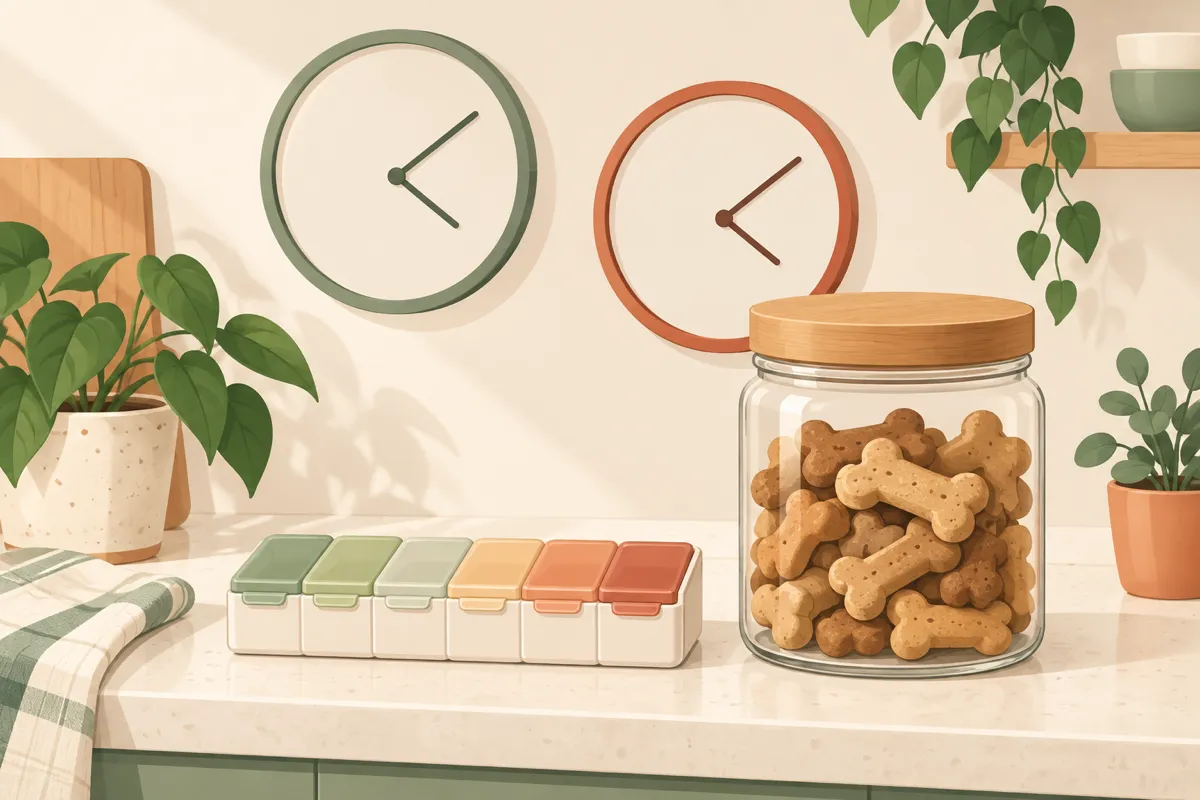
The time zone trap
Say your dog gets a thyroid tablet at 5pm, and you fly three time zones east. Some of these medicines are daily for life (the VCA guide to hypothyroidism notes the replacement hormone “must be given for the rest of the dog’s life”), so travel days are going to happen. What should the reminder do?
There are two sensible answers, and the medicine decides which:
| Type of medicine | What the reminder should follow | Example |
|---|---|---|
| With a meal | The local clock, because dinner moves with you | A tablet given with dinner |
| Strict spacing | The interval, such as every 12 hours | A twice-daily medicine |
| Due on a date | The calendar day, not a time | A monthly heartworm or flea dose |
What a reminder must never do is the accidental fourth thing: fire at the old time in the new place because the app stored a fixed moment. That is how a 5pm dose becomes an 8pm dose for a week without anyone deciding it.
The same trap catches date-based doses. A monthly heartworm tablet due “on the 14th” should come due on the 14th where your dog is, not at midnight in a city you left. The American Heartworm Society recommends giving heartworm preventive 12 months a year, so a monthly date will cross every holiday you take.
For any medicine that needs strict spacing, ask your vet before you travel how to handle the day you change zones. Do not let a phone alarm decide a safe gap between doses.
The handoff trap
The second common failure is the handover: a partner takes over for a trip, a sitter covers a weekend, the children own breakfast duty. Spoken handovers fail in two matching ways: the dose given twice, and the dose each person assumed the other gave.
The fix is plain: one shared schedule, visible to everyone, where giving the dose is recorded in the same place the reminder lives. The record is the message. A sitter who can see “last dose: this morning, 8:02” does not need to text anyone.
Before you travel: a checklist
- Ask your vet how to handle the time change for each medicine, and what to do if a dose is missed.
- Pack more than enough. Take extra doses in your hand luggage in case of delays.
- Check the rules if you cross a border. Taking a pet abroad has its own paperwork. In the UK, see taking your pet abroad.
- Write down the next due dates for flea, tick and worming doses that fall during the trip.
- After you land, check the next reminder on your phone and make sure notifications are on.
Practical rules for pet medicines
- Log the dose when it is given, not later. Memory merges identical daily events within hours.
- Give every schedule lead time. A refill reminder three days early beats a pharmacy dash on the day.
- Keep the schedule attached to the pet, not a person. Whoever is present should see what is due.
- Record the course, not just the habit: start date, dose, duration and prescriber, so “how long has he been on this?” has an answer at the next vet visit.
- Log late doses honestly. Record the actual time, and add a note. Your vet can only advise on what really happened.
Where Maggie fits
Maggie’s medication reminders handle time zones in three ways:
- A reminder set for a time of day, such as a 5pm tablet, follows your local clock when you travel. The due date stays on the day you set.
- An all-day reminder, such as a monthly flea dose, comes due on the same calendar date and arrives at a set morning hour, local time.
- A booked vet appointment with a time stays at that exact moment.
Reminders can arrive ahead of the due date, so there is time to buy a refill. Medicines and prescriptions live on the pet’s record, and you log each dose as a Medicine entry with the date, time and notes. Reminders are scheduled on the phone, so they work offline, and doses logged without signal sync later. On Pro, household sharing puts the same schedule and dose log on the phones of your partner, sitter or 14-year-old after syncing.
On Pro, you can also tell Leo “remind me to give Bruno his tablet every evening” and confirm the schedule he proposes. However the reminder is set, the medicine itself is your vet’s territory: never start, stop or change a dose without asking them.
Frequently asked questions
How do I give my dog medication when changing time zones?
Ask your vet before you travel, especially for medicines that need strict spacing. For a with-dinner medicine, many owners simply follow local dinner time. Check your next reminder after you land, and log each dose with the actual time.
What happens to phone reminders when I travel to another time zone?
It depends on the app. Some store a fixed moment, so the reminder fires at the old home time. In Maggie, a reminder set for a time of day follows your new local clock, and an all-day reminder stays on the same due date.
How do I stop my dog getting a double dose?
Keep one shared schedule and log each dose the moment you give it, so anyone can see it was given. Agree who gives which dose before a handover.
What should I do if I miss my dog's medication dose?
Check the leaflet and call your vet for missed-dose advice. Do not double up unless your vet tells you to. Log the actual time the late dose was given.
Care for your dog with Maggie & Leo
Keep your family's health records, vaccines, weight, and reminders organised in one calm place. Ask Leo for careful AI guidance grounded in your dog's real history. Free to start.
Related guides
-
How often should you flea your dog? It depends on the product
Most flea treatments for dogs last 1 month, some chews last 12 weeks and a collar up to 8 months. See the interval for each type, and why winter is no break.
-

When is flea and tick season for dogs? Months by country
Tick season runs from March to November in the US and UK, April to October in India, and most of the year in Australia. See the months for your country.
-
A weight plan for your dog, built from the scale and a body check
How Maggie's weight plan works: what it needs, the daily routine it gives, when it sends you to a vet first, and what it does when weight falls too fast.