A weight plan for your dog, built from the scale and a body check
Key facts
- Maggie's weight plan needs your dog's latest weight, a body check from 1 to 9 and your dog's age.
- A body check of 6 or 7 gets a plan for slow, steady loss. At 8 or 9, Maggie asks for a vet check first.
- Dogs under 12 months get no weight plan. Large breeds wait until 15 months and giant breeds until 18 months.
- If your dog loses more than 2% of body weight a week, Maggie pauses the plan and asks you to check in with your vet.
On this page
Maggie’s weight plan reads your dog’s latest weight and a hands-on body check from 1 to 9, then gives a daily routine of walks, a calorie amount and check-ins for slow, steady loss. Dogs that need a vet first, such as those with a body check of 8 or 9, get no plan until a vet has looked at them. For a quick feeding estimate before you start, try the dog food calculator.
Most dogs that carry extra weight got there slowly, one generous scoop at a time. Getting it off needs the same thing in reverse: a small, steady change that someone keeps track of. That is what the weight plan in Maggie is for.
What the plan needs
Three things, and a fourth that helps:
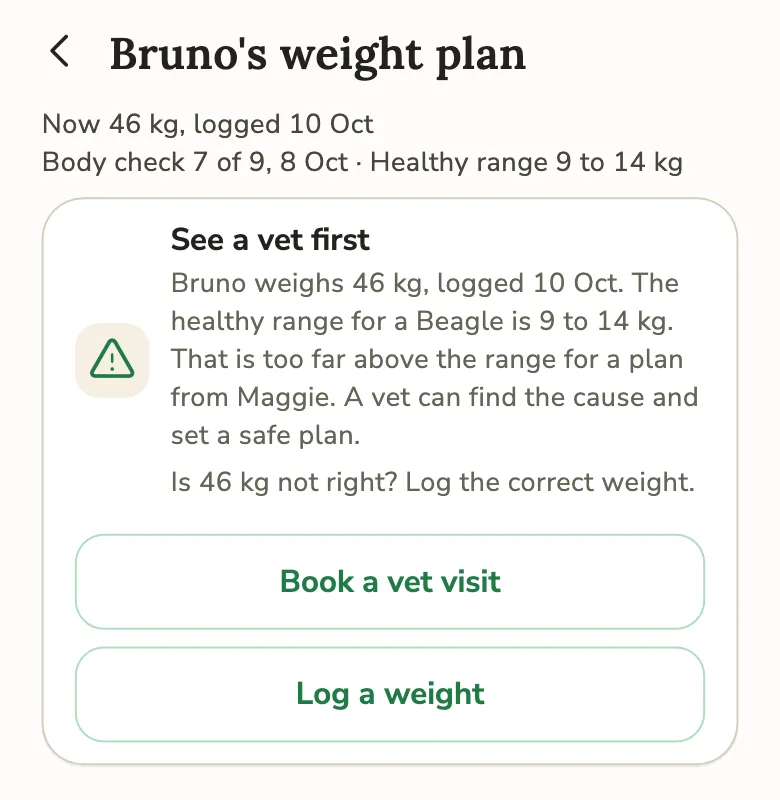
- A weight. The latest one you logged. The screen shows which one it used and the date, for example “Now 16 kg, logged 10 Oct”.
- A body check. The hands-on score from 1 to 9. Our guide to the body condition score shows how to do one at home.
- Your dog’s age. A dog under 12 months gets no weight plan, and a large breed waits until 15 months, a giant breed until 18 months. Growing puppies need feeding advice from a vet.
- The breed, if Maggie has a weight range for it. The plan works out an ideal weight from the weight and the body check, and checks it against the healthy range of the breed. For a mixed breed, or a breed Maggie has no range for, the plan uses the body check alone, and the screen says so: “Maggie has no healthy weight range for Mixed breed, so this plan uses Bruno’s body check.”
If one of these is missing, the app asks for it. It does not guess.
When Maggie offers a plan
A body check of 4 or 5 is ideal, and the plan is to hold steady. A body check of 6 or 7 means some extra weight, and the plan aims for slow, steady loss.
You then see the offer and a button, “See the plan”. Nothing starts on that tap. You read the routine first, and the plan begins only when you press “Start plan”.
When it says “See a vet first”
Some dogs should not start with an app. Maggie holds the plan back and says why:
- A body check of 8 or 9. “At 8 or 9 a vet must check him before a plan.”
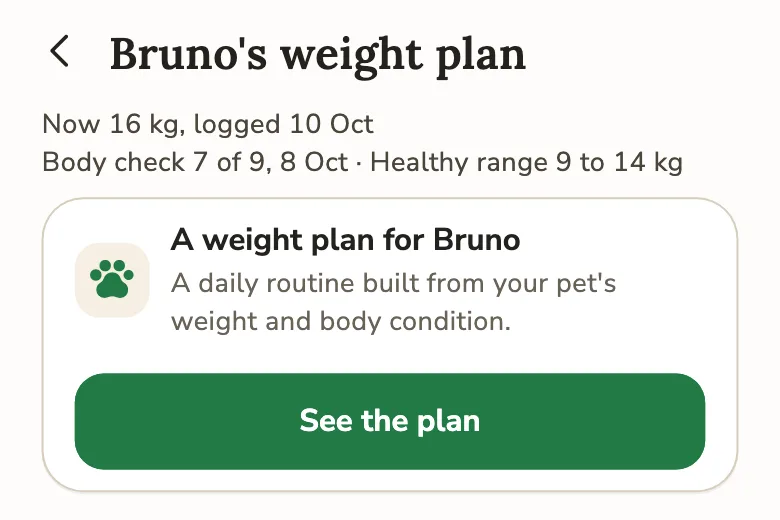
- A weight far above the healthy range. The screen names the weight, its date and the range for the breed.
- A body check of 3 or less, or a low weight. A low weight can point to something medical, so this needs a vet and not a feeding plan.
The message names the one record that holds the plan. If that record is wrong, there is a button to correct it: “Log a weight” or “Do a body check”. If it is right, “Book a vet visit” plans the visit.
For a low body check or a low weight, the first button is “What this means”. It shows a routine to gain weight, and that routine can start only after you switch on “My vet has cleared this”.
What the routine looks like
The plan is a daily routine, chosen for your dog’s size:
- Activity. A number of minutes a day, split across walks. A medium dog on a loss plan is asked for 70 minutes over 2 walks.
- Food. Less food, not a new diet. The routine shows about how many calories a day, worked out from the goal weight. If you set up the food plan, Maggie turns that into grams for each meal.
- Check-ins. A weigh-in every 7 days on a loss plan, and a body check every 30 days. On a plan that holds weight steady it is every 30 and 60 days.
Each day the plan shows one thing to do: log a walk, weigh him, or do a body check. After 4 weigh-ins over at least 2 weeks it also says how things are going: “The plan is working”, or “No change yet. Give it a few more weeks”.
You can pause the plan when your dog is away or not well, and resume it later.
The brake: losing too fast
Fast loss is not a win. If your dog loses more than 2% of body weight a week, Maggie pauses the plan herself and tells you: “That is faster than the safe range, so the plan is paused. Please check in with your vet.”
Helping the plan work
Most of the work happens in the kitchen. The PDSA names overfeeding and too little exercise as the most common reasons dogs gain weight, and gives three simple habits:
- Measure the food carefully. Weigh it on a kitchen scale rather than guessing with a cup or a scoop.
- Cut back the treats. Treats count. Take them from the day’s amount, not on top of it.
- Keep the weigh-ins regular. Weight loss works better with regular weigh-ins, and many vet practices have a scale in the waiting room you can use without an appointment.
Tell everyone who feeds the dog about the plan, so the extra biscuit from a grandparent or a sitter does not undo the week.
What it is not
The routines are general guidance. They were drafted for the app and have not been reviewed by a vet yet. That is why every plan carries the line “Please review this plan with your vet before you change food or exercise.” The plan does not diagnose anything, and it sets no promise of a weight by a date.
The weight plan is for dogs. For a cat, the app says: “Weight plans are not available for this pet yet.” You can still log a cat’s weight and follow it on the pet’s page.
Where Maggie fits
Maggie keeps the weights, the body checks and the walks in one place, so the plan reads your dog’s own numbers. Not sure where your dog stands today? Start with how much should my dog weigh? and one body check.
Leo is an AI companion, not a veterinarian. For medical concerns, and before any significant diet change, always consult your vet.
Frequently asked questions
How do I make a weight loss plan for my dog?
Start with a weight and a body condition check. Feed a measured amount for the goal weight, add daily walks, and weigh every week. Agree the plan with your vet before you change food or exercise.
How fast should a dog lose weight?
Slowly. Maggie treats loss of more than 2% of body weight a week as too fast and pauses the plan. Fast loss is not a win.
Can a puppy go on a diet?
Not from an app. Growing puppies need feeding advice from a vet, so Maggie gives no weight plan before 12 months, or 15 months for a large breed and 18 months for a giant breed.
When should an overweight dog see a vet before dieting?
At a body check of 8 or 9, at a weight far above the breed's healthy range, or at a body check of 3 or less. Maggie holds the plan back in each of these cases.
Care for your dog with Maggie & Leo
Keep your family's health records, vaccines, weight, and reminders organised in one calm place. Ask Leo for careful AI guidance grounded in your dog's real history. Free to start.
Related guides
-
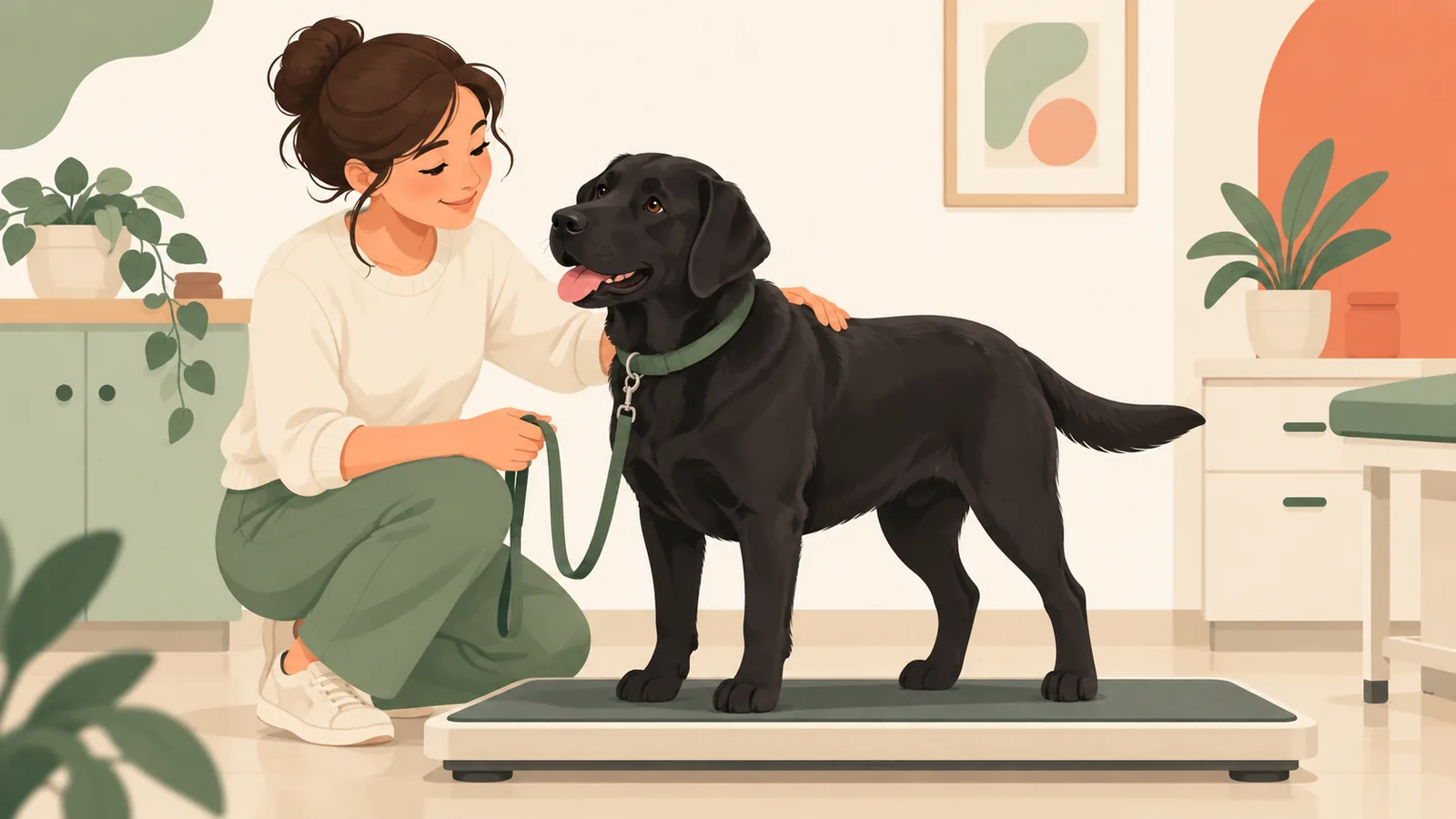
How much should my dog weigh?
Breed weight ranges are a starting point, not a verdict. Combine the scale, a body condition check and a monthly trend to know if your dog's weight is healthy.
-
Reading your pet's body condition score
The 1 to 9 body condition score explained: how to check your dog or cat at home in a minute, what the ideal 4 to 5 looks like, and why the trend matters most.
-

When is flea and tick season for dogs? Months by country
Tick season runs from March to November in the US and UK, April to October in India, and most of the year in Australia. See the months for your country.