How much should my dog weigh?
Key facts
- Your dog's ideal weight is the weight at which it has a body condition score of 4 or 5 out of 9.
- A breed range shows what is typical for the breed, not what is right for your dog.
- Weigh adult dogs monthly and puppies weekly, and watch the direction over months.
- Unexplained weight loss needs a vet visit, not a diet.
On this page
Your dog should weigh what it weighs at a healthy body condition: a score of 4 or 5 out of 9, where you can feel the ribs easily but not see them, and there is a waist from above. A breed weight chart gives you a rough band to check against, but it cannot tell you if a weight is muscle or fat. Use the scale, a body check and the trend together. For a feeding starting point at your dog’s weight, try the dog food calculator.
“How much should my dog weigh?” sounds like it should have a simple answer, and the internet is full of breed weight charts that pretend it does. The honest answer is more useful: the number on the scale only means something in context.
Why breed charts are only a starting point
A breed range tells you what is typical, not what is right for your dog. A tall, long-limbed Labrador and a compact one can both be perfectly healthy at weights 8 kg apart. Mixed-breed dogs may not fit any chart at all. And a chart says nothing about whether the weight is muscle or fat.
Breed ranges are still worth knowing. If your Beagle is far outside the typical band for Beagles, that is a prompt to look closer. Just treat the chart as a flag, not a diagnosis.
Typical adult weights for common breeds
These are typical adult ranges from kennel club breed standards, as Maggie stores them. They have not been reviewed by a vet, and they apply to adult dogs only.
- Labrador Retriever: males 29 to 36 kg, females 25 to 32 kg.
- Golden Retriever: males 29 to 34 kg, females 25 to 29 kg.
- German Shepherd: males 30 to 40 kg, females 22 to 32 kg.
- Border Collie: males 14 to 20 kg, females 12 to 19 kg.
- Beagle: 9 to 14 kg.
- French Bulldog: males 10 to 13 kg, females 8 to 11 kg.
- Pug: 6 to 8 kg.
- Indian Pariah dog: males 15 to 25 kg, females 12 to 20 kg. No single registry sets a standard for this breed, so this range is less certain.
A puppy is still growing, so do not compare it with an adult range. Large breeds can take 15 months to grow up, and giant breeds 18 months or more.
The better tool: body condition
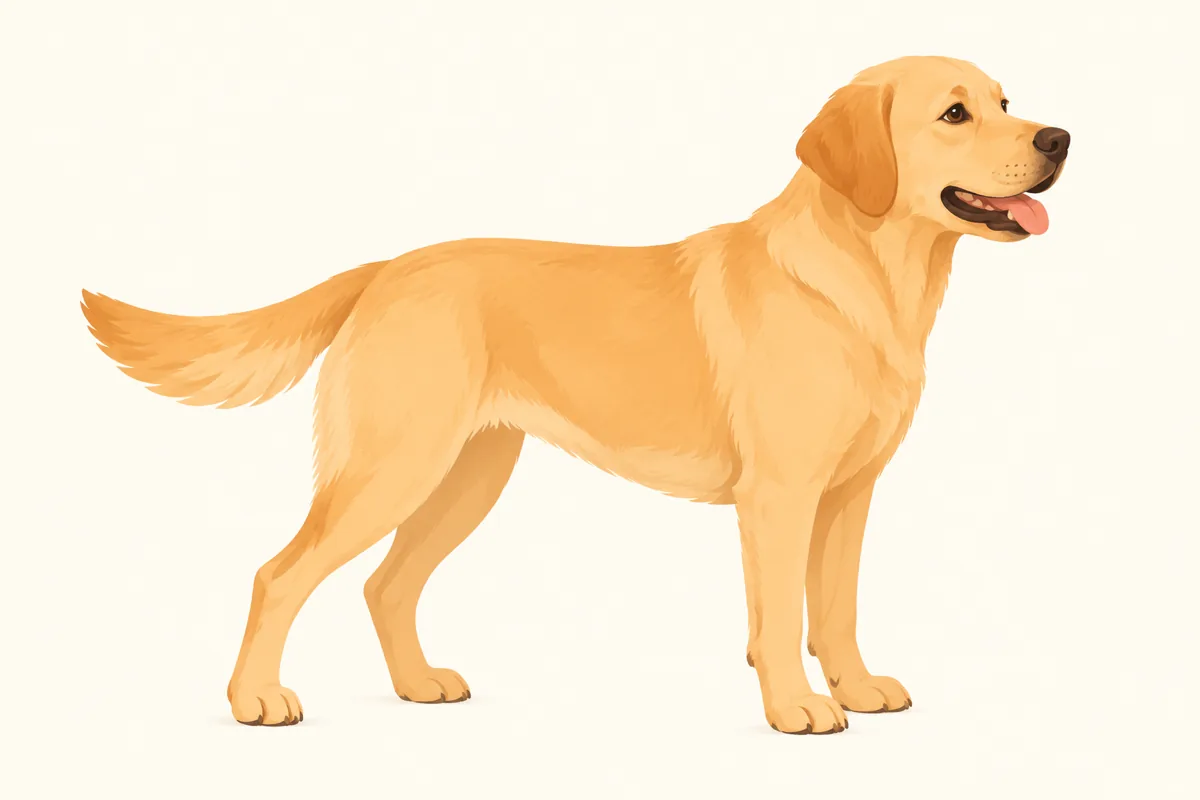
Vets pair the scale with a body condition score, a hands-on 1 to 9 assessment of how much fat your dog carries. Can you feel the ribs easily under a thin layer? Is there a visible waist from above and a tummy tuck from the side? A dog in the ideal range scores 4 to 5.
We wrote a full guide to reading your pet’s body condition score, including how to assess it at home. The short version: a dog can be “in range” on the chart and still overweight in body condition, and vice versa.
Working out a target weight
The body check gives you a target, even with no breed chart:
- Score your dog. If the score is 4 or 5, today’s weight is your dog’s healthy weight. Keep it there.
- If the score is 6 or more, estimate. A rough guide is about 10% extra body weight for each point above 5. A 22 kg dog that scores 7 carries about 20% extra, so a healthy weight is near 18 kg (22 divided by 1.2). This is an estimate, not a prescription.
- Check it against the breed range. If the estimate lands far outside the range, score again, or ask your vet to score your dog with you.
- Agree the target with your vet before you cut food, especially at a score of 8 or 9.
Some dogs need extra care. In flat-faced breeds such as Pugs and French Bulldogs, extra weight adds to breathing problems, so it is worth acting on a 6. In lean breeds such as Greyhounds, owners tend to score too low, and in thick-coated breeds the coat hides fat, so use your hands.
The trend beats the number
The single most useful thing you can do is weigh your dog regularly and watch the direction, because gradual weight change is almost invisible day to day when you live with a dog. A few practical habits:
- Weigh monthly for adults, weekly for puppies. Vet visits, pet shops with a scale, or the bathroom-scale trick (hold the dog, subtract yourself) all work. The PDSA notes that many vet practices have scales in the waiting room that you can use without an appointment.
- Use the same scale, at the same time of day. Before breakfast is easiest. Different scales can disagree by enough to hide a real change.
- Log it somewhere permanent. A number you cannot compare to last month’s is nearly useless.
- React to the slope, not the wobble. Daily fluctuations are normal. A steady three-month climb is the signal that matters.
- Rapid loss is a vet visit, not a diet win. Unexplained weight loss deserves professional attention promptly. Even on a planned diet, loss of more than 2% of body weight a week is too fast.
Where Maggie fits
Maggie plots your dog’s weight as a trend chart with the breed’s healthy range drawn in, and pairs it with a WSAVA-style body condition score so you get a plain verdict: under, ideal or over. If the data suggests a diet is needed, the app’s wellness plans are computed from your dog’s real numbers with safety gates first: severe cases, rapid loss and puppies are routed to your vet rather than handed a template. Our post on the weight plan shows how it works. Want a quick estimate first? Try our dog food calculator.
Ask Leo, the AI companion in the app, how much your dog should be eating and the answer comes from deterministic WSAVA calorie maths applied to your dog’s actual logged weight, not from model guesswork.
Leo is an AI companion, not a veterinarian. For medical concerns, and before any significant diet change, always consult your vet.
Frequently asked questions
How much should my dog weigh?
Your dog should weigh what it weighs at a body condition score of 4 or 5: ribs easy to feel but not seen, a waist from above and a tummy tuck from the side. A breed range gives you a rough band to check that number against.
How much should a Labrador weigh?
Kennel club ranges put adult male Labradors at about 29 to 36 kg and females at about 25 to 32 kg. A tall or compact Labrador can be healthy outside that band, so check the body condition too.
How do I work out my dog's ideal weight?
Do a body condition check. If your dog scores 4 or 5, today's weight is about right. Above 5, a rough guide is about 10% extra weight for each point, so ask your vet to confirm a target before you cut food.
How often should I weigh my dog?
Monthly for adults and weekly for puppies. Log each weight so you can compare it with last month's.
My dog is losing weight without a diet. Is that a problem?
Yes, it can be. Unexplained weight loss deserves a vet visit promptly, even if your dog seems well.
Care for your dog with Maggie & Leo
Keep your family's health records, vaccines, weight, and reminders organised in one calm place. Ask Leo for careful AI guidance grounded in your dog's real history. Free to start.
Related guides
-
Reading your pet's body condition score
The 1 to 9 body condition score explained: how to check your dog or cat at home in a minute, what the ideal 4 to 5 looks like, and why the trend matters most.
-
A weight plan for your dog, built from the scale and a body check
How Maggie's weight plan works: what it needs, the daily routine it gives, when it sends you to a vet first, and what it does when weight falls too fast.
-

A home-cooked recipe made for your dog, your country and your kitchen
How Maggie's food plan works: grams for each meal, recipes written for one dog from foods your family cooks, and the checks every recipe must pass first.